Risk Overview
Mango anthracnose, primarily caused by Colletotrichum gloeosporioides (and other species within the Colletotrichum gloeosporioides species complex), is one of the most economically significant pre- and post-harvest diseases affecting mango production worldwide. The disease is endemic to nearly all humid and sub-humid production regions, posing a consistent threat to yield stability, fruit quality, and export market access. In unmanaged or poorly managed plantations, under highly conducive environmental conditions, the disease can lead to substantial crop losses. This risk overview provides a management-level assessment of the disease’s impact, epidemiology, and strategic control options within an Integrated Pest Management (IPM) framework.
Pathogen Profile
The causal agents of mango anthracnose are species within the Colletotrichum genus, with Colletotrichum gloeosporioides being the most dominant species. Numerous other species within the C. gloeosporioides complex, including C. asianum, C. fructicola, C. siamense, and C. tropicale, have also been identified as significant contributors to the disease in various mango-producing regions. These fungal pathogens are capable of infecting all above-ground parts of the mango tree, including leaves, twigs, flowers, and fruit.
Development Conditions
The development and spread of mango anthracnose are highly dependent on specific environmental conditions. The pathogen’s conidia are dispersed primarily by rain splash, and free moisture is essential for infection. High relative humidity and warm temperatures (optimal range of 20-30°C) further favor spore germination, appressorium formation, and subsequent infection. Consequently, the disease is most severe in regions with prolonged wet or humid conditions during flowering and early fruit development. For commercial production operations, a thorough assessment of regional rainfall patterns and humidity levels is a critical first step in evaluating the long-term risk and feasibility of establishing or sourcing from major mango-producing areas.
Impact on Commercial Production
Anthracnose impacts commercial mango production across two primary fronts. Pre-harvest, the disease causes direct yield losses by inducing blossom blight (which leads to flower abortion), leaf spot (which reduces photosynthetic capacity), and premature fruit drop. Post-harvest, the impact is equally severe. The pathogen has a latent infection phase, meaning that fruit may appear healthy at harvest but develop characteristic sunken, black lesions during ripening and storage, rendering them unmarketable. This post-harvest decay drastically reduces the fruit’s shelf life and commercial value. In some regions, such as Ghana, anthracnose is responsible for significant fruit loss, with other countries reporting even higher levels of damage. The financial consequences extend beyond direct yield loss to include increased sorting and packing costs, reduced pack-out rates, and potential rejection of shipments by destination markets with strict quality standards.
Integrated Management (IPM Framework)
Effective management of mango anthracnose on a commercial scale requires a multi-faceted IPM approach that integrates cultural practices, genetic resistance, and, when necessary, targeted chemical or biological interventions. No single strategy is sufficient under high disease pressure.
Cultural Control
Orchard site selection is the foundational layer of management. Establishing orchards in areas with a distinct, dry season creates a less favorable environment for disease development. Within established orchards, canopy management through annual pruning improves airflow and reduces within-canopy humidity. Sanitation-the removal and destruction of infected leaves, twigs, and mummified fruit-is essential to reduce primary inoculum sources. Mulching can be used as part of an integrated crop management program, contributing to disease suppression by preventing soil splash of conidia onto lower fruit and leaves.
Host Resistance
Resistance to anthracnose is a highly valuable trait, although complete immunity is not yet available in commercially acceptable cultivars. Research has shown that anthracnose tolerance within mango germplasm is variable, and no commercial cultivar is sufficiently resistant to be produced in humid areas without additional management inputs. However, several cultivars have demonstrated useful levels of tolerance or moderate resistance and can be incorporated into breeding programs or considered for lower-risk production zones. Production operations should evaluate the relative susceptibility of target cultivars and consider the cost-benefit of integrating more tolerant varieties into their supply chains.
Chemical Control Considerations
In production systems where environmental conditions are highly conducive to disease, a well-timed and carefully executed fungicide program may be an essential component of a comprehensive management strategy. The objective is to protect flowers and developing fruit during critical periods of susceptibility.
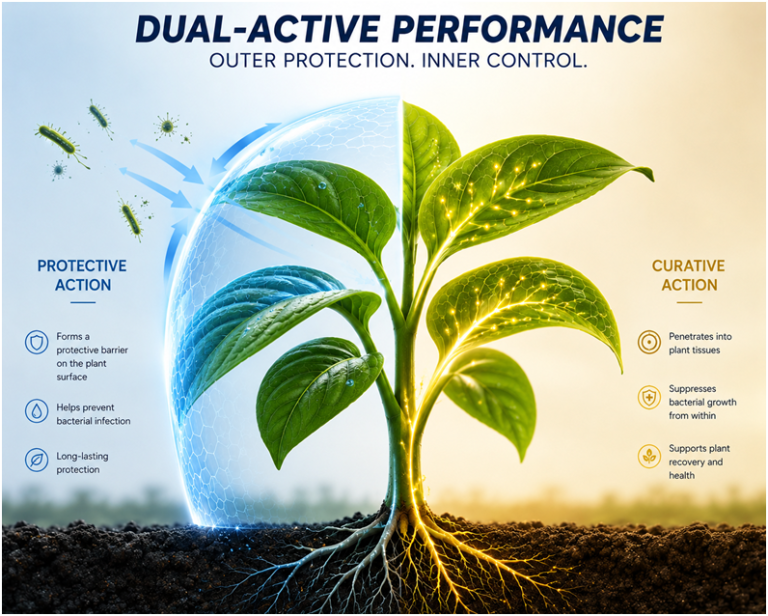
The choice of fungicide and the overall program design are significant management decisions. In regions with sustained disease pressure, fungicide programs may be incorporated as part of a broader seasonal disease management strategy, subject to local agronomic assessment and regulatory requirements. A range of fungicide groups are used globally. These include copper-based fungicides, which offer broad-spectrum protectant activity, and systemic fungicides that provide curative activity. In certain production areas, formulations such as King’s Care may be considered as part of a rotational program, subject to local registration status and approved product labels. To mitigate the risk of resistance development, adherence to resistance management principles-such as rotating active ingredients with different modes of action-is essential. It is critical to emphasize that all fungicide applications must be made in accordance with approved local product labels and are subject to local registration status and regulatory requirements.
Biological Control
The use of biological control agents offers a sustainable complement or alternative to chemical fungicides within an IPM framework. Research over the past several years has yielded a number of promising microbial isolates. Antagonistic bacteria have demonstrated the ability to suppress Colletotrichum growth through antibiotic production and competition for nutrients and space. Antagonistic yeast strains have also shown significant efficacy in reducing post-harvest anthracnose development while maintaining fruit quality, presenting a promising alternative to synthetic fungicides. For large-scale production, incorporating biological control agents as part of an integrated program, particularly in the post-harvest phase, can reduce reliance on chemical inputs.
King Quenson Support Statement
King Quenson is well positioned to support importers and large-scale agricultural operations in developing tailored, compliant IPM strategies based on local conditions and regulatory requirements.
Disclaimer
This article is based on publicly available agricultural extension materials and general integrated plant protection practices. Management recommendations should be adapted to local conditions and regulations.