Overview
The codling moth (Cydia pomonella Linnaeus) remains one of the most economically significant pests of apple production across all major pome fruit growing regions. Its long history of adaptation to diverse climates and repeated insecticide applications has made it a persistent challenge for commercial orchards. For those involved in high-value fruit supply chains, the presence of codling moth directly affects fruit quality, post‑harvest stability, and compliance with international phytosanitary standards.
Traditional reliance on broad-spectrum insecticides has become increasingly problematic due to regulatory restrictions, environmental concerns, and widespread resistance. Therefore, a preventive, area-wide strategy based on Integrated Pest Management (IPM) principles is essential. Such an approach supports sustainable population suppression while preserving market access and reducing long-term management risks.
Pest Profile
Cydia pomonella (Lepidoptera: Tortricidae) is now established on six continents, having spread from its Eurasian origin to all major apple-growing regions. A key management challenge arises from its multivoltine nature: depending on temperature, one to four overlapping generations can occur per year. This asynchrony means that eggs, larvae, pupae, and adults may be present simultaneously in an orchard, making it difficult to target a single susceptible life stage with any single intervention.
The pest’s ability to complete multiple generations within a single growing season directly increases the frequency of re-infestation. If the first generation is not adequately suppressed, subsequent generations can build rapidly, leading to escalating fruit damage. For management programs, this overlapping biology necessitates continuous monitoring and repeated, carefully timed interventions rather than a single-application strategy. Understanding this generational complexity is therefore essential for designing effective IPM programs.
Risk Factors
Codling moth development is strongly temperature-driven. Warmer spring and summer conditions accelerate larval growth and adult emergence, often compressing generation intervals and extending adult flight periods. This phenological shift makes it more difficult to precisely target susceptible life stages using traditional forecasting models. High orchard density and the presence of untreated host trees, such as abandoned orchards or backyard apple and walnut trees, serve as refuge populations that re-infest managed blocks.
Lack of coordinated area‑wide management further exacerbates infestation pressure. Climate change has also introduced greater variability in seasonal temperatures, reducing the reliability of degree-day models in some regions. Consequently, frequent, adaptive monitoring is required to capture actual pest activity rather than relying solely on historical predictions.
Impact on Commercial Production
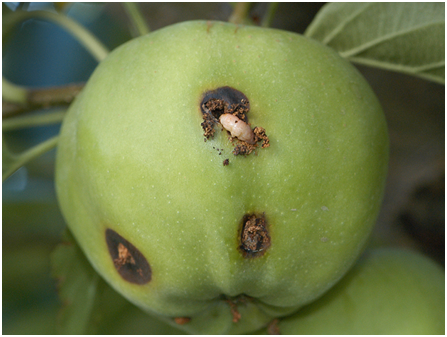
Initial feeding by first-instar larvae produces a small, red-ringed entry hole on the fruit surface, often near the calyx or side. As the larva tunnels toward the core, it fills the cavity with brown frass, rendering the internal flesh and seeds inedible. Damaged fruit may ripen and drop prematurely, and infested apples are highly susceptible to secondary fungal rot during storage and transport.
For fresh export markets, tolerance thresholds for codling moth damage are extremely low, often below 0.5% infested fruit. Even moderate infestation levels can lead to rejection of entire consignments and trigger quarantine restrictions in importing countries. In unprotected orchards, economic losses from direct yield reduction and downgraded fruit quality are substantial, affecting both producer profitability and supply chain reliability.
Prevention and Management (IPM Framework)
Effective management of codling moth requires an area-wide IPM strategy that targets multiple life stages. Regular monitoring using species-specific pheromone traps provides essential data on adult emergence and population pressure, enabling timely interventions. Mating disruption, achieved through the deployment of synthetic sex pheromone dispensers, reduces the ability of males to locate females. This technique is most effective when applied over contiguous orchard blocks of several hectares with initially low pest density.
Sanitation practices, including prompt removal and destruction of infested or dropped fruit and winter removal of loose bark, help reduce overwintering sites. Biological control agents, such as codling moth granulovirus (CpGV) and entomopathogenic nematodes, can be integrated to target larval stages. Conservation of natural predators, including earwigs and parasitoid wasps, further supports long-term suppression. Chemical control, when required, should be deployed as a complementary component within this IPM framework, guided by monitoring thresholds and rotated by mode of action to delay resistance.
Management Options
Within an IPM framework, chemical control should be viewed as one of several tactical options, not as a default response. When population pressure exceeds the suppressive capacity of cultural, biological, and mating disruption tactics, selective insecticide use may be considered. The key principle is to apply products only when monitoring indicates a clear need, and to rotate among different modes of action to delay resistance development. This approach preserves the long-term effectiveness of available chemical tools and reduces unintended impacts on beneficial arthropods.
Beyond chemical inputs, additional supportive solutions include the use of codling moth granulovirus (CpGV) for larval control, entomopathogenic nematodes for overwintering stages, and attract‑and‑kill devices that combine semiochemicals with small amounts of insecticide. These tools can be particularly valuable in organic production or in orchards where insecticide resistance is already established.
For growers seeking registered product options that fit within a rotational program, King Quenson offers products such as King’s Trophy and King’s Archer, which represent examples of insecticides with distinct modes of action. Their integration into an IPM schedule must be based strictly on local registration status, approved product labels, and the regulatory requirements of the country where they are to be used. No application rates, timing intervals, or efficacy claims are provided here, as these parameters are determined by national and regional authorities.
The selection of any supportive solution, whether biological, semiochemical, or chemical, should be guided by local pest pressure, resistance monitoring data, and the overall IPM strategy. Growers are encouraged to work with local agronomic advisors to design a compliant, site-specific program that balances efficacy, regulatory adherence, and long‑term sustainability.
King Quenson Support Statement
King Quenson works alongside commercial growers and agricultural operations to develop practical, compliant IPM strategies that respect local growing conditions and regulatory frameworks. Our approach emphasizes risk identification, integration of multiple control tactics, and support for informed decision-making, without offering product‑specific guarantees or replacing local expert judgement.
Large-scale Grower Perspective
From a commercial standpoint, codling moth management is fundamentally about protecting production stability and reducing year-to-year variability. The objective is to contain infestation risk within acceptable thresholds that support consistent yield, pack-out rates, and export compliance. Integrating pest risk assessment into orchard planning, harvest logistics, and supply chain agreements contributes to improved predictability and operational alignment. For commercial growing operations, this means moving from reactive treatments to a systematic, monitoring-driven IPM framework that aligns with both production deadlines and regulatory requirements.
Disclaimer
This article is based on publicly available agricultural extension materials and general integrated plant protection practices. Management recommendations should be adapted to local conditions and regulations.