
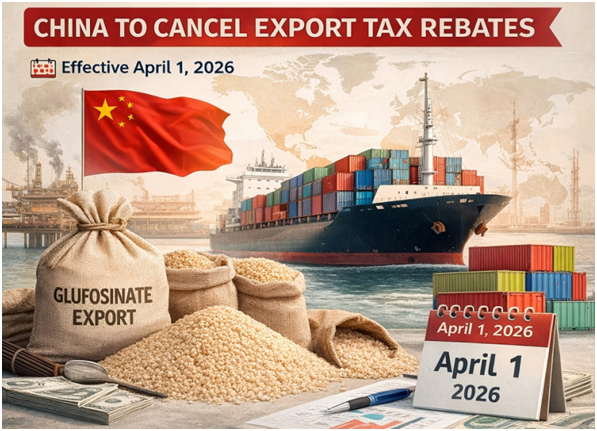
China has announced a policy adjustment affecting export tax rebates for a range of products, including several pesticide-related items. According to the report, the Ministry of Finance and the State Taxation Administration jointly issued a notice on January 9 stating that, effective April 1, 2026, the value-added tax (VAT) export rebate for certain products will be abolished.
The report indicates that more than 20 customs codes involved in the adjustment are directly related to the pesticide industry. The listed products include several widely traded active ingredients and intermediates, such as glufosinate, acephate, ethephon, and other agrochemical-related products. This policy change may draw close attention from export-oriented manufacturers, importers, and downstream procurement participants.
Among the products mentioned, glufosinate is identified in the report as the one with the largest export volume. AgroPages statistics cited in the article show that global glufosinate import volume exceeded 50,000 tons in 2021, 70,000 tons in 2022, and 85,000 tons in 2023, reflecting continued growth in international demand.
The article also notes that the main regions for global glufosinate demand include North America (over 25,000 tons), China (over 20,000 tons), Brazil and South America (over 15,000 tons), and Asia-Pacific (over 10,000 tons). Given the scale of demand and the product’s role in international trade, changes in China’s export tax treatment may become a factor influencing future export pricing, trade flows, and procurement strategies.
At this stage, the policy signal is mainly relevant from a market and supply-chain perspective. As the implementation date approaches, industry participants may pay closer attention to product cost structures, export quotations, order timing, and destination-market competitiveness across affected product categories.