
France is reportedly preparing an investment plan worth approximately €2 billion to strengthen domestic fertilizer production and reduce the country’s reliance on imported agricultural inputs.
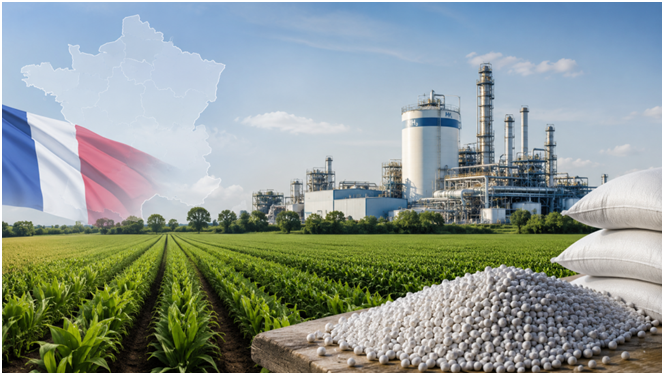
According to a Bloomberg report published on July 9, 2026, the initiative is intended to support France’s fertilizer supply security as European agriculture faces continued uncertainty surrounding energy costs, international trade and global supply chains.
France currently relies heavily on overseas suppliers for nitrogen fertilizers. Industry research indicates that more than two-thirds of the nitrogen fertilizer consumed in the country was imported in 2024, leaving the agricultural sector exposed to fluctuations in natural gas prices, transportation costs and geopolitical developments.
Supporting Domestic Fertilizer Production
The proposed investment is expected to encourage the development or modernization of fertilizer production capacity within France. A key area of interest is likely to be lower-carbon ammonia and nitrogen fertilizer production, including technologies that use renewable or low-carbon electricity instead of conventional fossil-fuel-based processes.
Several industrial projects involving renewable hydrogen and low-carbon ammonia are already being developed in France. These projects aim to provide more stable fertilizer supplies while reducing greenhouse gas emissions associated with conventional ammonia production.
The investment plan also reflects a broader European effort to improve strategic autonomy in agricultural inputs. In recent years, the European Union has introduced measures intended to diversify fertilizer supplies, promote nutrient recycling and lower farmers’ dependence on imported mineral fertilizers.
Fertilizer Supply Becomes a Strategic Issue
Nitrogen fertilizer production is closely linked to natural gas, which is both an energy source and a raw material used in ammonia manufacturing. As a result, fertilizer prices can be significantly affected by changes in global energy markets.
Supply disruptions and higher production costs have increased concerns about the competitiveness of European fertilizer manufacturers. At the same time, farmers remain sensitive to rising input costs, which can influence fertilizer application decisions and potentially affect crop productivity.
France’s proposed investment therefore seeks to balance several objectives, including maintaining sufficient fertilizer availability, improving domestic industrial capacity and supporting the transition toward lower-emission agricultural production.
Potential Implications for the Fertilizer Market
If implemented, the program could create new opportunities for fertilizer manufacturers, engineering companies, clean-energy developers and agricultural technology providers.
However, the development of new fertilizer capacity will depend on factors such as electricity prices, access to low-carbon hydrogen, regulatory approvals, production costs and long-term demand from farmers.
Domestic production is also unlikely to eliminate the need for fertilizer imports completely. International trade is expected to remain an important part of France’s fertilizer supply, particularly for raw materials and fertilizer types that cannot be produced competitively within the country.
The planned investment nevertheless signals that fertilizer security is becoming an increasingly important component of France’s agricultural, industrial and energy policies.
As further details are released, the industry will be watching how the funding is allocated, which production technologies receive support and how quickly new capacity can be brought into operation.